
Luc Bigé's Astromythology

Hello, Welcome to Luc Bigé's astromythology blog
This site is proposed to you to present some myths from the work of Luc Bigé in his School of Symbols, https://reenchanterlemonde.com/mythologie/
What is the link between mythology and astrology, and why are we interested in Greek mythology?
The stories of the different myths are intended to give us the keys to understand them and apply them to our astrological birth chart. They allow us to avoid the traps they have set for us during our evolution in order to understand ourselves. Greek mythology, close to our European origins, gives us the possibility to live and discover similarities with different mythological heroes and to integrate them into our lives with particular vigilance. The fundamental objective remains to be close to the myth in order to fulfil our essence.

You can now access our blog Luc Bige Astromitologia in Portuguese.
Enjoy your reading
Information in advance
We have try to translate into English and Portuguese the essential of the myths from Luc Bigé's réenchanter le monde website. It includes an introduction to some of these myths. Their correlation with the signs and planetary configuration in astrology.
If you wish to visit the Reenchanting the World website, click on the link below:
The values of the 12 labours of Hercules in brief
We are told that the 12 labours of Hercules represent the 12 steps to the totality of what human consciousness can experience and that they signify a truly heroic journey. It is a journey full of struggles, some of which are in acceptance and some in transformation. The author suggests that we pay attention to the times when we are more open, more accepting, more letting go, more open to whatever comes up in our lives. And at what other times we need to develop sufficient energy to transform the shadow and psychic energies that appear.
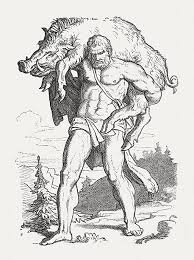
Heracles and the boar of Erymanthe, illustration of the third work of Hercules.
Mythology of Greek antiquity
Myths are alive and carry a symbolic meaning that touches the collective and individual unconscious of different cultures around the world.
The capture of the Erymanthe boar
Luc Bigé gives us his interpretation of this third work of Hercules. The ancient Greeks had a way of seeing that the future was behind them and the past in front of them. Whereas we are used to saying exactly the opposite. The way to justify this thought was obvious and quite unstoppable in the sense that the future was obviously behind them since they did not see it and did not know it. And the past is obviously in front of them since they can see it and know it.
The author will teach us that the logic of this understanding is linked to the point of view from which we look at it. From the point of view of the personality, the future will be a question of an objective which is effectively in front of us, there is something to reach a desire, a will of... What is the point of view of the Self, the Sun, the Erimanthe boar? The Self or our soul holds the memory of our future. It sees our future, it holds the memories of our future.
From this point of view, we can become aware of the meaning of the boar on Hercules' back and that, at that moment, Hercules becomes aware of his destiny, of what his soul has planned for him on the spiritual plane.
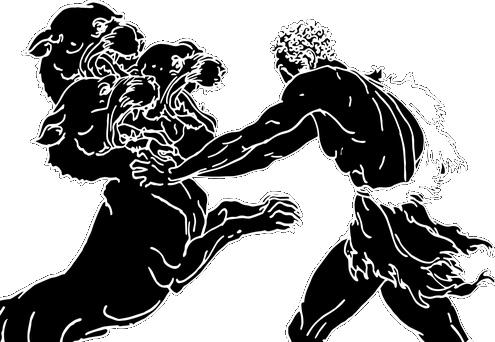
The first of the labours of Hercules, the lion of Nemea.
When he successfully smothers the Lion, the hero begins to listen to the sounds that come from inside. Now he is taking a step forward: by smothering the animal, he learns to be silent. He knows his strength, he knows that he is often right, but he learns to keep silent. The hero begins his metamorphosis by giving up his greatest quality.
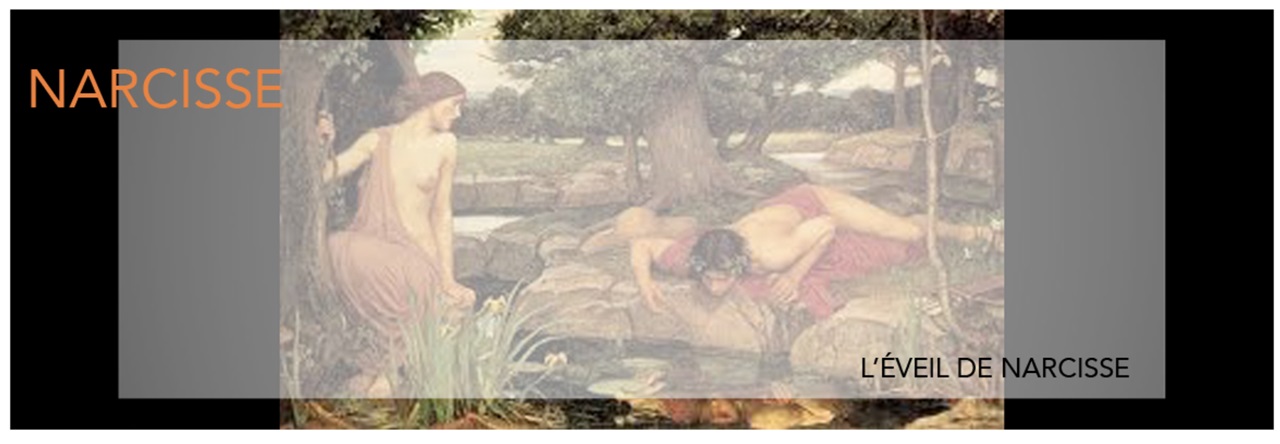
"The essentials” of the Narcissus myth
The story tells of a process of inner evolution. The stages are very well described and lead to an awakening, to coming out of the narcosis. Step by step, Narcissus learns to know himself and therefore, according to the prophecy of the soothsayer, he will die to his former identity in order to be reborn in the splendour of the flower that bears his name.
Picture illustrating the loss of Eurydice
When Orpheus loses Eurydice, he will enter a period of despair and repentance. Repentance is the ability to shed tears to cleanse his suffering, to understand the cause of his mistake and to start again on his true path.
The myth invites the Orphic ones to continue to frequent what is essential for him even if he thinks he has lost it once, even if he feels he will never be able to reach his goal. It is thanks to this frequentation that he will be capable to find true love.
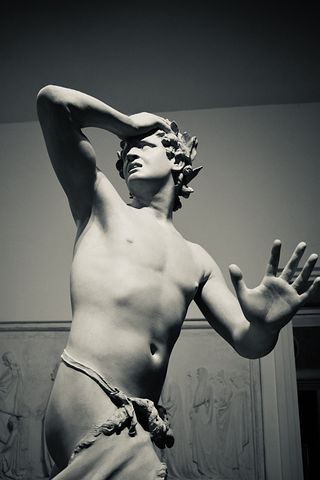

Introduction to the symbolism of the Faust myth
Since the discovery of Pluto in 1930, which represents an impulse towards the superman, the idea of the Aryan superman has become a reality, claiming that the Aryan race can only triumph over the subhuman: on 14 July 1933, the German Reich introduced a "hereditary health policy". And in Russia, there was also an attempt to create a new communist man, which means that Pluto/Faust remains in search of a transformation of human nature. And today, a third attempt is being made with technology and is called transhumanism. These attempts to change human nature are very Faustian. From the author's point of view, the only attempt that makes spiritual sense is the work of Aurobindo. Sri Aurobindo also lived in the 1930s and died in the 1950s. He said that by bringing down the supra-mind, which is beyond the mind, into the cells of the body, one will be able to transform human nature by changing its genetic code and moving towards a new species. Thus, every Faustian attempt is to move towards a new species.
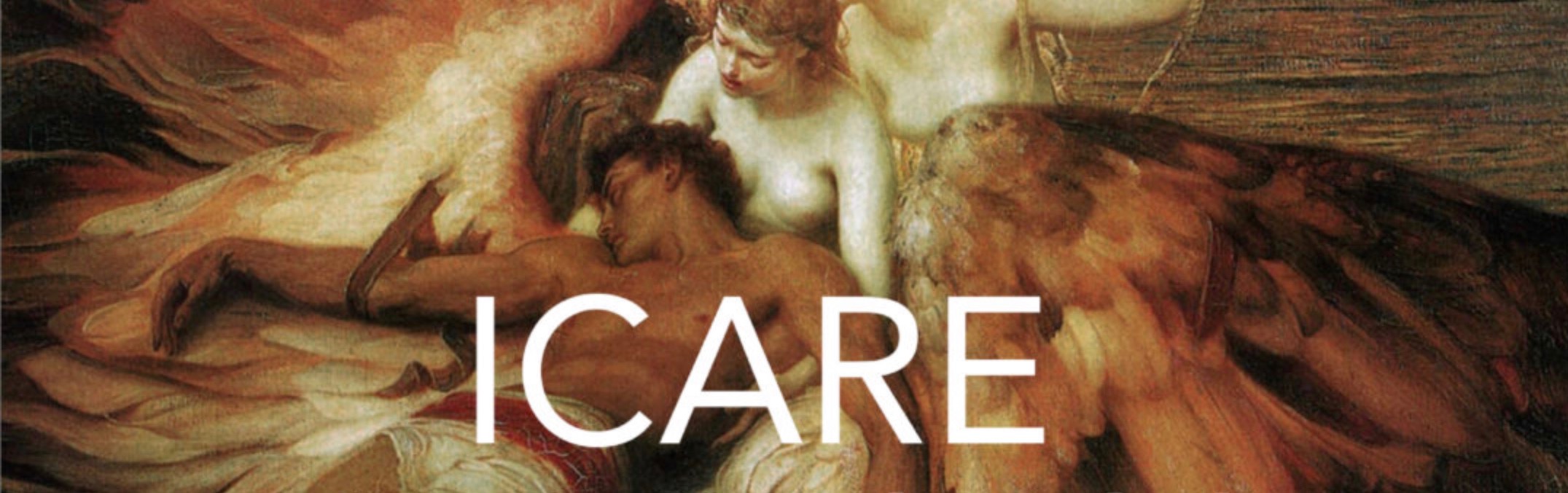
Introduction to the myth of Icarus, the passion for the sun
An examination of structural symbols, Icarean pathologies, and liberation operating principles (related to the Platonic cave allegory, Glaucos' animal wisdom, Minos, etc.) is conducted in order to challenge the philosophical underpinnings of technical thought. This essay explores the postérité of the myth through the works of A. de Saint-Exupéry and R. Kipling. The symbolic reading of Icare and Dedale's adventures offers the reader a fresh perspective on our technological society and suggests a number of paths out of the mazes that sometimes swallow up our lives. Icare, as an example, is a powerful call to life beyond the daily repetitions imposed by our societyofcontrol.
